
If you are wondering what to see in Bursa first, start with the Koza Han courtyard and Ulu Cami. Add the village of Cumalıkızık if you have time for a separate journey beyond the centre. These three places explain why the World Heritage listing puts a city and a village together. A stone lane gives you the scale of a settlement on Uludağ’s slopes, a covered entrance leads to a trading courtyard, and a low doorway opens into the wide interior of a mosque. Each place rewards a slower look at the way buildings meet the space around them.
The street sets the pace in Cumalıkızık
In Cumalıkızık the paving is part of what you notice first. On a short walk even a few steps can change the view of a stone wall, a timber upper floor or the space left between two houses. Look across the lane before you look for an isolated photo of a house. The narrow interval explains why the buildings can feel close enough to speak to one another. The village sits on the slopes of Uludağ. UNESCO describes it as the rural part of a system that helped sustain the early Ottoman capital.

Treat the lanes as public routes through an inhabited village. Pause where residents can pass, and keep the camera pointed at architectural details when a portrait has not been invited. Do not assume an open gate leads to a room you can visit. After rain, allow more time on the uneven surface. If you are travelling with a stroller or prefer to avoid a long incline, look at the first stretch before choosing a turnaround point. A look at the stone and timber from one quiet corner can be as instructive as reaching the top of a longer lane.
A detail worth spotting is the meeting of the stone lower walls and the lighter timber above. The two materials change the shape of the lane at different heights.
Koza Han turns a market street into a courtyard
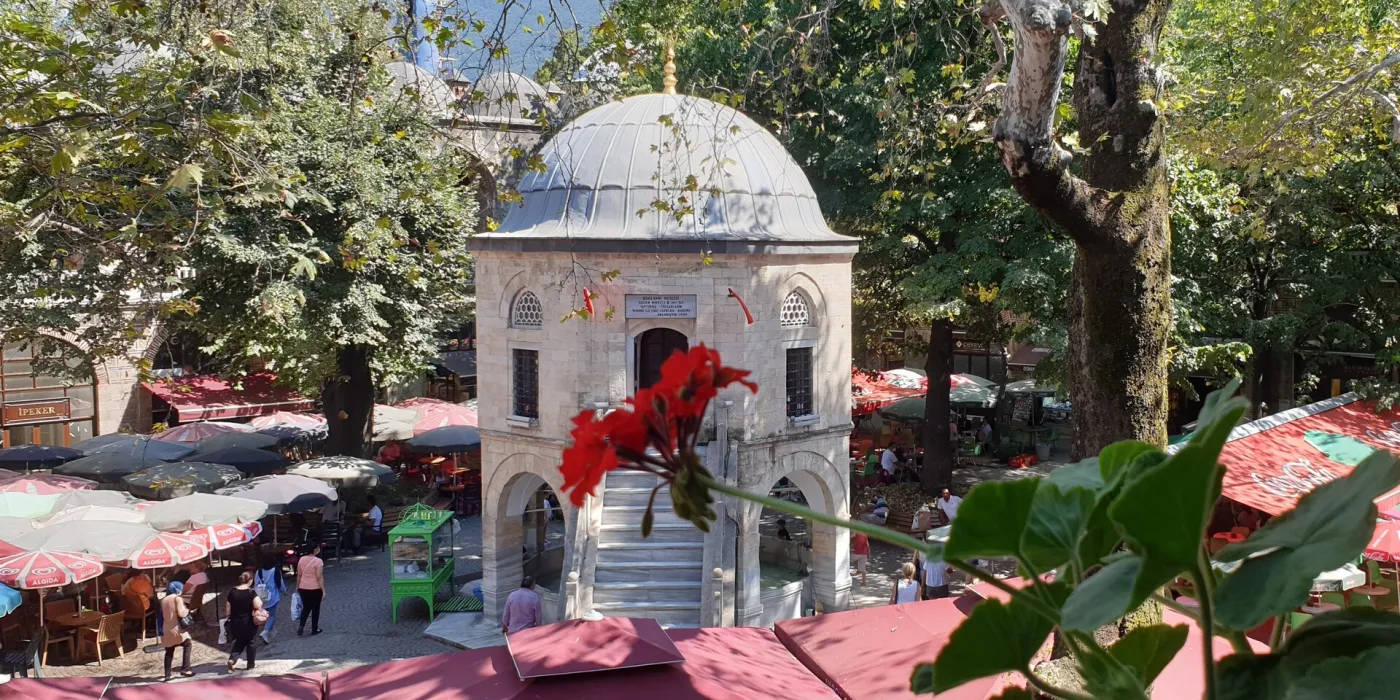
Approach Koza Han from the historic market district. The pause after you cross the entrance is worth taking. The street becomes a court surrounded by shops and passages, with a small mescid, or prayer hall, in the middle. You can follow the arcades with your eyes and see where visitors re-enter the market. If you stop for tea, choose a seat from which you can still watch people arrive and leave. The geometry of the building is easiest to see once you are looking from inside.
Visit Bursa credits the foundation of Koza Han to Sultan Bayezid II and links the revenues to his charitable foundation in Istanbul. The courtyard brings the commercial history of Bursa down to a human scale. Traders and visitors could pass through the same narrow opening and find rooms and shaded circulation around an open space. Silk is still strongly associated with the han. If you are shopping, ask what a textile is made of and how it was produced. If you only want to look, take time to walk the arcade and notice how the doors and route around the court are organised.
UNESCO describes the market hans alongside religious foundations that could include mosques, schools, bathhouses and kitchens. It is an invitation to look at a district as a whole. Koza Han was built in a later period than the establishment of Bursa as the early Ottoman capital. Visiting one courtyard and one mosque lets you pick up traces of different periods without confusing the buildings or treating every stop as a monument with exactly the same purpose. Children can look for a shape repeated across the arcade or compare the scale of two entrances.
Read Ulu Cami through its roof and its quiet interior
Seen from the square, Bursa’s Grand Mosque is striking for its width. The municipal tourism portal describes twenty domes, supported by arches and substantial piers. Look up from a position where visitors can stand without blocking the passage, then look for the interior fountain and the calligraphy. Ulu Cami is a working mosque. Dress respectfully, follow the signs about footwear, and check the visitor arrangements for the day. If people are praying, save your photograph for another time.

The mosque and Koza Han are close enough to see on a single walk through the bazaar. Pay attention to the shift between the low covered edge of the courtyard and the broad space beneath the mosque’s domes. Each interior changes what you see when you return to the street. If travelling with children, make a three-image challenge out of it. Spot a stone passage in the village, a court beyond a gate at the han and one repeated detail on the mosque. A short list of observations leaves room for a slower visit.
Getting there without building the day around the ferry
BUDO says its Istanbul terminal moved from Eminönü/Sirkeci to Kabataş on 1 January 2026. For the crossing to Mudanya, confirm the terminal and the schedule for the date you are going. Mudanya is a separate arrival point from the historic centre. Allow time for the onward ride to Bursa and check your return connection before going on to Cumalıkızık. If you choose another ferry company, consult its own terminal information. For the village, use an up-to-date local route planner or arrange the transfer separately. Do not count the time spent on the water as the full travel time between Istanbul and the bazaar.
Is Bursa a sensible day trip from Istanbul?
Yes, if you make the historic centre your main aim and check how much time remains for the village. For a calmer visit to both places, stay overnight in Bursa. A short trip becomes easier when you save the locations as separate pins: Bursa Koza Han, Ulu Cami and Cumalıkızık Köyü. Look up where the return starts, then give yourself time for one last walk or a quick meal before going back. If you have to choose the final detail to remember, stand at one entrance and look back towards the street. Its width and light say more about the place than a hurried list of stops.
Terminal, heritage and visitor information checked on 27 November 2026.
Official visitor and transport information
UNESCO · Bursa & Cumalıkızık · Visit Bursa · UNESCO · Visit Bursa · Koza Han · Visit Bursa · Ulu Cami · BUDO · Kabataş & Mudanya · BUDO · Sefer duyuruları
Photography and licences
Koza Han courtyard and its small prayer hall in Bursa — Mkadioglu2020, Wikimedia Commons, CC BY-SA 4.0 (cropped to 16:9 and resized).

A stone lane between traditional houses in Cumalıkızık — Kumkum, Wikimedia Commons, CC0 1.0 (resized).

Exterior of Bursa’s Grand Mosque, Ulu Cami — Hcanardic, Wikimedia Commons, CC BY-SA 4.0 (resized).
